
Claremont’s Shock Invoice
Claremont’s school budget crisis—already a five-alarm fire—now has an accelerant: a nearly $870,000 mid-year invoice from SchoolCare, the nonprofit health-benefits pool that covers many NH districts. That bill lands atop an existing ~ $5 million deficit and tight cash-flow projections, forcing immediate triage on spending and reserve use.
What SchoolCare Is (and is not)
SchoolCare is a member-owned risk pool: districts pay premiums into a common pot used to pay claims and keep modest reserves. It is not a traditional for-profit insurer. For most plans, SchoolCare contracts Cigna to run the Open Access Plus network and process claims (the third-party administrator, or TPA); in 2025 it also added a Harvard Pilgrim Health Care (HPHC / Point32Health) option. In short: SchoolCare holds the risk; Cigna/HPHC run the plumbing.
A note on costs often cited in these briefings: GLP-1 drugs (Ozempic/Wegovy, etc.) are recurring pharmacy spend across many members; gene therapies are rare, one-time spikes. They’re different budget problems—one slow bleed, one thunderclap—and both have hit plan costs statewide.
Numbers: Where the Money Went Sideways
After back-to-back high-claim years depleted reserves, SchoolCare’s board approved a $30 million assessment across members, proportional to what each pays in. Interest is waived if paid by Jan. 1; afterward, it’s 0.05% monthly, and districts have until July 15 before benefits are at risk for nonpayment. The capital-region hit list includes Allenstown, Chichester, Deerfield, Epsom, Franklin, Kearsarge Regional, Pembroke, and Shaker Regional. SchoolCare says it returned surpluses for 12 straight years (2012–2023) and has never done an assessment until now.
Claremont Case Study (Sullivan County focus)
Claremont’s ~$868k–$870k SchoolCare bill arrives amid severe cash-flow strain and a push to cut the overall deficit roughly in half by summer. Options on the table mirror other districts: tap trust funds and savings, freeze hiring and travel, reconsider plan design and reinsurance, and stage payments to avoid interest after Jan. 1. Given Claremont’s thin monthly balances through winter, timing the payment matters as much as the amount.
How Other Districts Are Absorbing the Hit
| District | Assessment (approx.) | Immediate steps noted | Source/Date |
| Concord | $1.9–$2.0M | Trust funds; freezes; reassessing vendor options for 2026 | Concord Monitor, Sep 30/Oct 2, 2025 |
| Lebanon | ~$1,000,000–$1,033,216 | Use budgeted-but-unspent health dollars + savings | NHPR, Oct 1, 2025; WMUR, Sep 28, 2025 |
| Somersworth | $672,000 | Seeking city assistance after 14% premium hike | NHPR, Oct 1, 2025 |
| Claremont | ~$868k–$870k | Evaluating this-year vs. next-budget timing; freezes likely | NHPR, Oct 1, 2025; Valley News, Oct 2, 2025 |
Scope: ~65 school districts (plus ~25 other public employers) received invoices ranging from $1,000 to $2,000,000. Nine districts topped $1M; Londonderry reportedly had the highest at ~$2M.
Simple Graphic: Who Does What (risk-pool & labor map)
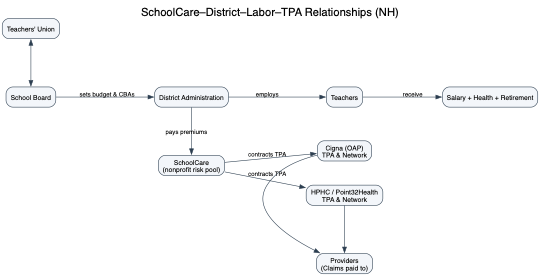
The Economics of a Teacher’s Compensation Package (plain-English)
A teacher’s total compensation has three big pieces:
• Salary structured by steps and lanes (years of service and education credits), negotiated in the collective bargaining agreement (CBA), and approved by the school board.
• Health benefits, usually the single biggest non-salary item: the district as employer pays most of the SchoolCare premium each month; employees pay the remainder via payroll deductions. A sudden assessment works like an extra bill on top of premiums—an immediate employer-side cost that wasn’t appropriated last March.
• Retirement via NHRS: both teacher and district contribute a fixed percentage of pay to the state pension system. Rates are set statewide, not locally.
When a mid-year health assessment lands, the district must plug it with reserves, spending cuts, or revenue changes, because salaries and NHRS rates are relatively inflexible mid-cycle. In tight districts, that crowds out repairs, curriculum, or staffing plans—hence the scramble for hiring freezes, trust-fund withdrawals, or staggered payments to avoid interest after Jan. 1.
“GLP-1 spend is a faucet; gene therapy is a fire hose. Both fill the bucket—one slowly, one all at once.”
Accountability & Options
Key questions for boards and taxpayers:
• Reserves & timing: Were SchoolCare’s reserves sized for two deficit years? Did members get a timely heads-up once the actuarial update arrived in August, and were alternatives to an assessment fully aired? SchoolCare says this is its first assessment in 30 years after 12 years of surplus returns.
• Plan design & utilization: Are GLP-1 criteria, dose escalation, and adherence managed to clinical standards? Are high-cost therapies carved out with reinsurance or stop-loss?
• Market check: With double-digit 2026 increases projected, should districts RFP the TPA/network (Cigna vs. HPHC) or consider alternative pooling/self-insurance models used by larger cities?
What to watch next (Claremont)
• Cash-flow line: Does Claremont pay SchoolCare before Jan. 1 to avoid interest, and how does that intersect with winter cash lows?
• Mitigation menu: Which cuts/freezes or trust-fund uses the board actually adopts—and when they bite.
• 2026 premiums: Whether Claremont stays with SchoolCare/Cigna, shifts to HPHC, or solicits alternatives after this shock.
Sources & Footnotes
– NHPR (Oct 1, 2025) — “School districts look at savings and hiring freezes to cover a $30 million health care bill.” Includes statewide scope (~65 districts), Claremont (~$870k), Somersworth ($672k), interest policy, and nine districts >$1M.
– Concord Monitor (Sep 30, updated Oct 2, 2025) — “’A huge shock’: Concord among hardest hit…” Lists affected capital-area districts; confirms $30M assessment; interest begins Jan 1; 12 years of surplus returns; first-ever assessment; Concord’s adequacy/valuation context.
– Valley News (Oct 2, 2025) — “Claremont School District tackles $5 million deficit.” Cash-flow projections and deficit management plan.
– WMUR (Sep 28, 2025) — “NH school districts being asked to pay more…” Mentions ~90 public entities; Lebanon around $1.03M; Concord ~ $2M.
– SchoolCare (official site, 2025) — Cigna OAP administration; HPHC partnership (April 2025 announcement).
Discover more from The Sullivan County NH Republican Committee
Subscribe to get the latest posts sent to your email.

 The Sullivan County NH Republican Committee