

By Emily Sandblade
Last March, I ran for a seat on the Claremont School Board and lost. Nowadays, I’m thrilled that I did.
Besides the relief of not sitting on the business side of the table at school board meetings and facing a large crowd of upset and fearful people, I can now engage in a bit of “told ya so.”
Grants and Mismanagement
I frequently said that local entities like the school system and the local government should be cautious about what federal and state grants they accepted.
SAU 6 (and apparently the school board) believes the more grants, the merrier. But the school administration clearly couldn’t handle the volume, so here we are—looking like deer in the headlights.
The main reason some grants aren’t worth pursuing is that studies show taking a federal grant costs the recipient about 1.5 times the revenue from the grant.
SAU 6 is like the naïve businessman who loses on every small transaction but insists he’ll make it up on volume.
I never would have thought administrative mismanagement (and I am hoping it’s only mismanagement) would be so severe that taking grants became even more unprofitable.
A Growing Financial Hole
So here we are. There’s a big hole in school revenue, the money has long been spent, and vendors have been left unpaid for weeks and months.
Now, Claremont City Councilors sitting on the business side of the table have to co-sign a loan that looks an awful lot like kicking the can down the road.
Due to state law, the City Council can’t set requirements for the district to get its act together. To get out of this mess, the School Board will need to do some and/or all of the following:
- Close things
- Sell stuff
- Fire people
- Raise taxes
Generally, the go-to approach has been #4: raise taxes. (Or, in Claremont’s case, try to take from other districts.) This is no longer a viable approach.
The Numbers Don’t Lie
Take a look at the spreadsheet below showing demographics and school statistics for the last nine years.
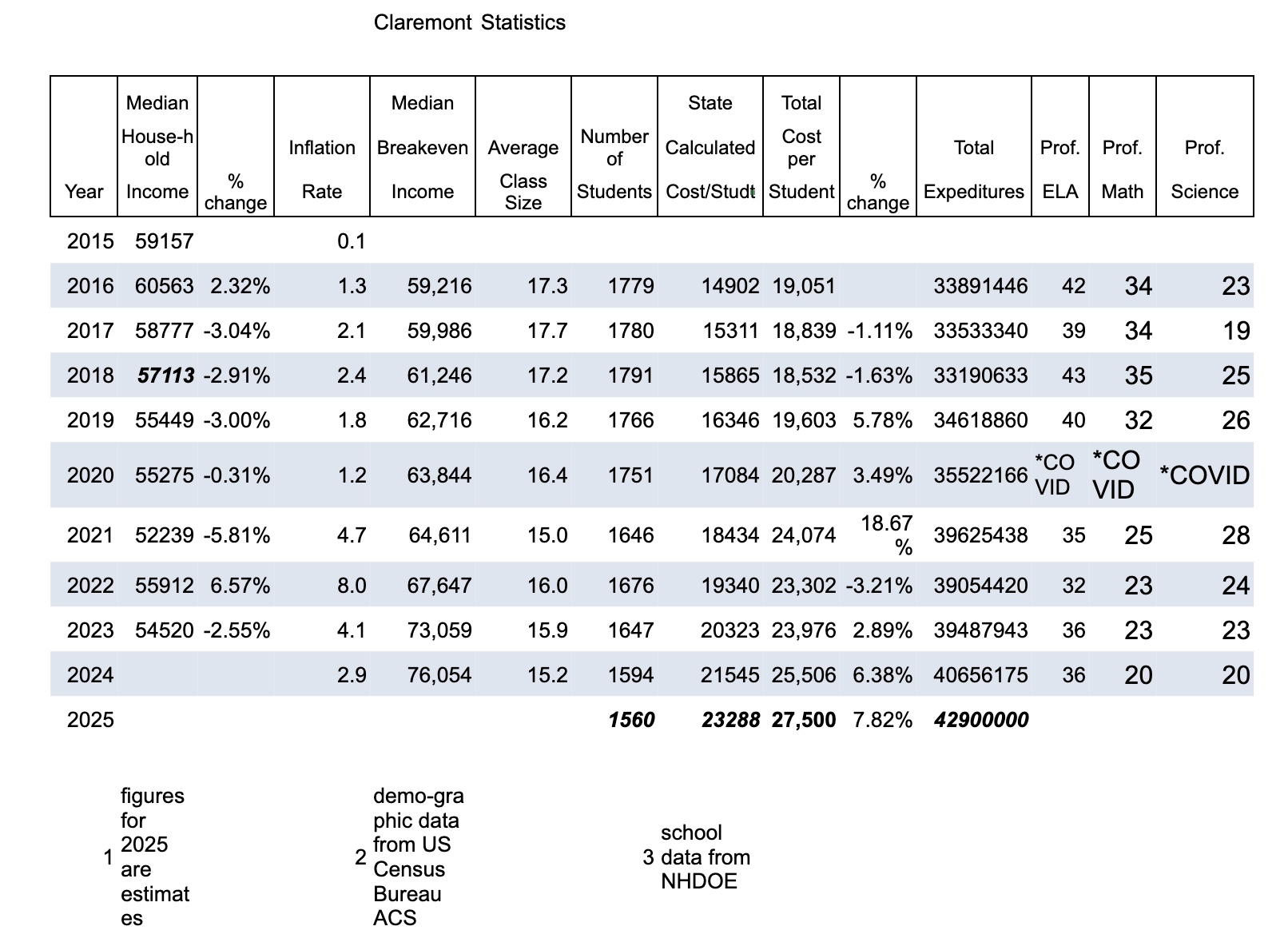
The numbers show that Claremont is economically crashing.
- Median household income has declined from $60,583 in 2016 to $54,520 today—about $6,000 less.
- Adjusted for inflation, median income should be around $76,000, which is $22,000 higher than it is now.
- School costs per student have risen 50% between 2016 and 2024.
You don’t need to be a rocket scientist to see this is not sustainable. In fact, with declines in all proficiency scores, we’re not likely to see a lot of rocket scientists coming out of Claremont.
- English Language Arts (ELA): 42% → 36%
- Math: 34% → 20%
- Science: 23% → 20%
What This Means for Taxpayers
This is what the town of Claremont is being asked to co-sign a note for, thereby committing taxpayers to either:
- higher taxes, and/or
- significant cuts to town services.
I’m not going to suggest rejecting the loan to the SAU, but I am going to suggest a couple of bitter medicines to go with that sweet, sweet money:
- The city should use every scrap of influence and its bully pulpit to clean up the management of the SAU.
- The city must slow the downward spiral and refrain from pushing the property tax to over 10% of the median household income.
Time to Act
We are already at the point where:
- our houses are devalued,
- our business community has been crippled,
- our town’s reputation is that of a very business-unfriendly place, and
- our workforce is poorly educated.
Raising taxes while failing to fix the education system that provides the future fuel for economic survival will simply push Claremont closer to total economic failure.
This impending disaster needs to be viewed as an opportunity to get our city’s and our school system’s act together.
Let’s not waste it.
Blog post contributed by Emily Sandblade
Discover more from The Sullivan County NH Republican Committee
Subscribe to get the latest posts sent to your email.

 The Sullivan County NH Republican Committee
Nothing is mentioned about what claremont already receives from the state per pupil…
Around $14,000 which is twice what the conval judge is saying the state must pay!
Judy Aron
NH State Representative
House Environment & Agriculture Committee Chair
Sullivan County District 4
Acworth, Goshen. Langdon, Lempster, and Washington
266 Forest Rd., South Acworth, NH 03607
603-843-5908
Sent from my Verizon, Samsung Galaxy smartphone
LikeLike
I copied it and posted on FB…..
On Wed, Sep 3, 2025 at 11:48 AM The Sullivan County NH Republican Committee
LikeLike