Author: Rep. Steven Smith

  • How New Hampshire’s Paltry Rainy Day Fund Stacks Up

    Rainy Day Fund Comparison

    New Hampshire’s Rainy Day Fund – sometimes called the Revenue Stabilization Account and in other states may be called the Budget Reserve Account – was tapped by previous legislatures under Democrat control to maintain or increase spending levels in the down economy.

    Under the 2012-2013 Republican budget, New Hampshire was left with a surplus. While most of the money in the surplus was used to help fund the 2014-2015 budget, there is about $15 million left over.

    What should we do with the money? Republicans in the House and Senate agree that we need to begin rebuilding our Rainy Day Fund. In a presentation to the Senate Finance Committee in January, then State Treasurer Cathy Provencher agreed. She said in order to maintain New Hampshire’s credit rating, we should strive to have a balance equal to 5%-10% of unrestricted general fund revenue.

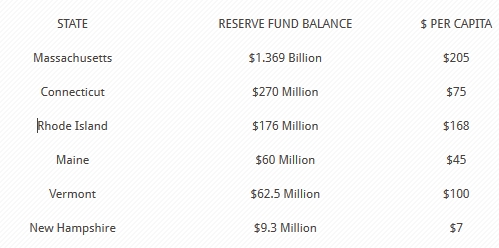
    5% = $70 million, 10% = $140 million. Our current balance of $9.3 million equals just 0.7% of General Fund Unrestricted Revenue.

    House Democrats have passed a bill, HB 1411, that spends a large portion of the surplus. They have also passed a bill, HB 1635, that spends some of the projected surplus from the current budget.

    We decided to take a quick look to see how New Hampshire stacks up to our New England neighbors when it comes to financial security. As it turns out, New Hampshire ranks last in both overall balance, and when balance is compared to the overall population of the state. Here are the results, given the more recent information we could find.
    RainyComp

    It’s time to bring New Hampshire back from the brink. SB415, a bill that would deposit the entire $15 million surplus into the Rainy Day fund, will be before the House soon. We have the chance to begin to rebuild New Hampshire’s financial security. $15 million may not get us to our goal, but it is a small and important step.
    – See more at: http://nhhousegop.com/new-hampshires-paltry-rainy-day-fund-stacks#sthash.Cls3a290.dpuf

  • New Sales Tax

    State Senate defeats State House’s Sales Tax on Paint

    On Thursday, the New Hampshire State Senate took up House Bill 1570. This legislation, which was passed by the State House in March by a vote of 161-142, would have created a sales tax on paint ranging from 35 cents per pint to $1.60 on anything over a gallon.

    Thankfully, the State Senate defeated the amendment proposed by the Senate Energy and Natural Resources Committee with a bipartisan vote of 16-7. The State Senate then moved a motion declaring the bill inexpedient to legislate, which passed with a voice vote.

    In recent days, Citizens for a Strong New Hampshire had been reaching out to and encouraging residents to contact their State Senator to tell him or her to oppose House Bill 1570.

    Like most Granite Staters, we are baffled that our legislators in Concord are even discussing preposterous bills such as a sales tax on paint. However, we do commend the State Senate for putting the brakes on yet another tax and spend policy endorsed by the liberal majority in the State House.

    Our elected officials should be focused on implementing policies that lower taxes and increase economic opportunities for all Granite Staters. Instead, some in Concord are constantly trying to find new ways to take more money from them. New Hampshire residents and small businesses deserve better, which is why our organization will continue to fight terrible pieces of legislation such as House Bill 1570 at every turn.

  • Gas Tax passes

    Concord – New Hampshire Republican State Committee Chairman Jennifer Horn released the following statement on today’s vote on the gas tax by the New Hampshire House of Representatives:

    “A gas tax hike during challenging economic times is wrong for New Hampshire because it will unfairly burden the middle class and hurt small businesses. Democrat Governor John Lynch was right when he vigorously opposed a gas tax increase and said that the state needs to do a better job managing its existing funds instead of trying to take more money out of thepockets of working families. By vowing to sign this tax hike, Governor Maggie Hassan continues to prove that she is no John Lynch, and that she is out of touch with New Hampshire’s fiscally responsible values.”

    Background: Governor John Lynch: “Before we consider the need for additional revenue – which I don’t think is there – we need to manage the funds that we have today, which we are not doing well,” he said in a meeting with editors from The Citizen and Foster’s Daily Democrat. (Lynch Vows To Fight Gas Tax, Laconia Citizen, 8/30/2007)

  • Making sense of the gas tax

    Whether or not you support the concept of a gas tax increase, we thought it would be helpful to clarify some of the misconceptions about SB367. With all due respect to the bill and its supporters, before jumping into a major tax increase, we need to take a hard look at the intricacies of this bill and the system by which the revenue would be used.

    We hope you find these points informative.

    Misconception #1: This bill’s sole purpose is to help improve infrastructure.

    No. This bill, as written, removes some tolls in Merrimack, which results in a loss of revenue to the Turnpike Fund. Many people believe toll planning should be solely the responsibility of the 10 year Highway Plan. Trying to attach such legislation to a tax bill is not appropriate. Consideration of the removal of tolls should be part of a broader review of our highway and turnpike systems, it’s revenue, and how funds are allocated, to avoid any adverse or unintended consequence.

    Misconception #2: All of this new tax revenue will be distributed to help fix secondary roads and bridges in NH.

    No. This bill, as written, allocates 42% of revenue to the I-93 widening project. The I-93 widening was already allocated $50 million as part of the 10 Year Highway Plan, HB2014, which has already passed the House and is currently in the Senate.

    Misconception #3: A large portion of tax revenue will be distributed to cities and towns to immediately help repair municipal roads.

    No. Municipal block grants will not commence until FY2016 and will be just 12% of the prior years’ revenue. In FY2016, additional aid to towns and cities resulting from the tax increase will be just $4 million per year statewide.

    Once divided up, most NH towns will get less than 1% of that amount. The largest cities and towns may get 1%-6%.

    Towns are not required to spend their block grant on infrastructure repair.

    Misconception #4: The new revenue is in a “lock box” and can only be used by DOT for infrastructure improvements.

    RSA 9:9-b allows the legislature to divert up to 27% of highway fund revenue to other state agencies, above and beyond what those agencies are appropriated through the state budget.

    The 2012-2013 budget violated RSA 9:9-b by diverting more than the specified amount.
    The 2014-2015 budget suspended RSA 9:9-b to divert even more than the previous budget.

    Since RSA 9:9-b took effect in its current form, 2 out of the last 3 of state budgets have gone over the limit. In the last 2 budgets alone, $38 million has been diverted from the highway fund in excess of the allowable amount in RSA 9:9-b.

    SB367 may state that the new revenue can only be used for specific purposes, but if the legislature can’t even follow a reasonable standing law regarding highway funds, how can we say that the provision in SB367 won’t be disregarded or suspended for future budget years?

  • NHGOP STATEMENT ON SENATE GAS TAX VOTE

    NHGOP STATEMENT ON SENATE GAS TAX VOTE

    Concord – New Hampshire Republican State Committee Chairman Jennifer Horn released the following statement on the Senate vote to raise the gas tax:

    “A gas tax hike during challenging economic times is wrong for New Hampshire because it will unfairly burden the middle class and hurt small businesses. Democrat Governor John Lynch was right when he vigorously opposed a gas tax increase and said that the state needs to do a better job managing its existing funds instead of trying to take more money out of the pockets of working families. By vowing to sign this tax hike, Governor Maggie Hassan continues to prove that she is no John Lynch, and that she is out of touch with New Hampshire’s fiscally responsible values.”

    Background: Governor John Lynch: “Before we consider the need for additional revenue – which I don’t think is there – we need to manage the funds that we have today, which we are not doing well,” he said in a meeting with editors from The Citizen and Foster’s Daily Democrat. (Lynch Vows To Fight Gas Tax, Laconia Citizen, 8/30/2007)